>
Why Iceland?>
A country for All Seasons>
Exploring extremes in the great outdoors >
Reykjavik - Iceland’s Big Little City >
Iceland 101>
Eat, Drink and be Merry >
Shopping in Iceland more than you bargain for>
Before You Go>
Icelandic Culture>
History>
FAQ about Iceland>
Climate and Weather Land Iceland is an island of almost 40,000 square miles, the same size as Ohio. Iceland''s highest peak, Hvannadalshnjukur, is 6,500 feet. Iceland has the largest glaciers in Europe - in fact, 11% of the country is covered by glaciers. The coastline is dotted with more than one hundred fjords and green, fertile valleys extend from many of them. Iceland also has more than 10,000 waterfalls and countless hot springs. A lot of the country is technically uninhabitable, with the moss-covered rocks of ancient lava flows and tall treeless mountains, but these moonscapes – the NASA astronauts actually trained in Iceland before the first moon landing – are perfect for exploring an other-wordly looking place.
Energy Situated on the Mid-Atlantic Ridge, Iceland is a hot spot of geothermal activity. Thirty volcanoes have erupted in the past two centuries, and natural hot water supplies much of the population with cheap, pollution-free heating. Rivers are harnessed to provide inexpensive hydroelectric power. For visitors, this also means access to the country’s hundreds of clean and friendly geo-thermally heated outdoor swimming pools, a true Icelandic experience. The electrical current is 220 volts, 50 Hz, the same as in much of Europe.
Language The Icelanders still speak the language of the Vikings (Old Norse, now called Icelandic). It is in the same family of languages as Norwegian, Danish and Swedish. Iceland also keeps the ancient Norse tradition of using patronyms rather than surnames. So someone called Magnus Petursson is Magnus, the son of Petur. If Magnus has a daughter, she might be called Margret Magnusdottir, or Margret, the daughter of Magnus. Women do not change their names when they get married (after all, they can never become the son of someone else!) and so a husband, wife, son and daughter of the same family can all have different last names. That’s why people almost always use only first names in Iceland – people even refer to the President as just Olafur, and never Mr. Grimsson!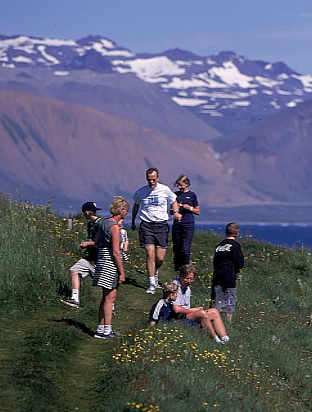
People Iceland has a population of 300,000 and more than half live in the Greater Reykjavik area. The official language is Icelandic but most Icelanders speak fluent English. A small percentage of the population was born outside of Iceland. The largest minority groups in the country come from the other Scandinavian countries, Eastern Europe and South-East Asia.
Time In spite of its mid-Atlantic location, Iceland is on Greenwich Mean Time all year round.
History The first permanent settler of Iceland was Ingolfur Arnarson, a Norwegian Viking who around 874 AD made his home where Reykjavik now stands. In 930 AD, the Viking settlers of Iceland founded one of the world''s first parliaments. They established a constitution based on individual freedom, land ownership, and sophisticated inheritance laws. In the year 1000, Icelandic-born Leifur Eiriksson ( also known as Leif Eriksson or "Leif the Lucky") became the first European to set foot in North America. On another Viking expedition a couple of years later, Icelander Gudridur Thorbjarnardottir had a son, Snorri, who became the first child of European descent to be born in America. The Old Commonwealth Age, described in the classic Icelandic Sagas, lasted until 1262, when Iceland lost its independence to Norway, and later Denmark. In 1944, it peacefully gained full independence from Denmark and the present republic was founded. The country is governed by the Althing (Parliament) which has 63 elected members. Elections are also held every four years for the presidency; current President Olafur Ragnar Grimsson has held the position since 1996.
Economy Iceland’s economy is heavily dependent upon fisheries, which are the nation''s greatest resource. Seventy-two percent of all exports are made up of seafood products. Yet only a small proportion of the workforce is active in this sector (4.4% in fishing and 5.6% in fish processing). About 66% of the workforce is employed in services. Icelanders enjoy one of the highest standards of living in the world.
Health Life expectancy, at 80 years for women and 74 for men, is one of the highest in the world, and a comprehensive state health-care system aims to keep it that way.
Church The National Church of Iceland, to which 97 percent of the population belongs officially, if not always in practice, is Evangelical Lutheran. In addition to the many Lutheran churches, there is a Roman Catholic Cathedral in Reykjavik, with holds regular Sunday Mass, often in English.