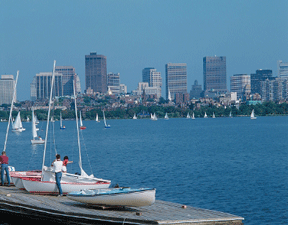
 We Will Be In Boston To Meet You!
The Iceland Tourist Board and Icelandair will be at the Boston Globe Travel Show, March 24-26, 2006. We hope you make time to stop by and chat with us at booths 303 and 305. We will have information about the all the wonderful destinations in Iceland. This is the opportunity you have been waiting for, and now is your chance to meet us and plan your first trip to Iceland. For more informaition on the Boston Globe Travel Show log onto http://www.bostonglobetravelshow.com. To book your flights to Iceland log onto http://www.icelandairholidays.com/
Travel From The U.S. To Iceland Is Up
Great news: travel from the U.S. To Iceland was up 20% in January of this year compared to January 2005. We are happy and thankful that more and more U.S travelers are choosing Iceland as their destination for vacations and meetings. The reasons for this are many, and we know the main reason is that more and more professional travel agents are offering Iceland as a destination. We hope even more will offer Iceland in the coming months, and we will do what we can to provide new comers with all the information they would need to sell Iceland. We have wonderful brochures and DVDs that we can send to you free of cost. Order the 2006 brochure or download it for free by our logging on to http:// www.goiceland.org/
Checking in with Iceland's Hardy Westman Islanders
 The newest chapter of The Explorers Club was established last summer in Iceland. And for a good reason. Iceland is right up there as one of the most adventurous destinations in the world. The home of geysers, active volcanoes, and bubbling hot pots, its otherworldliness attracted NASA astronauts in the 1960's for moonwalk training. In fact, NASA is still sending researchers to study the dynamics of water and rock formations to better interpret whether water might still exist in ice form on Mars.
Dateline traveled to the Westman's recently to check in with some puffin experts.
Rescuing “Parrots of the Sea”
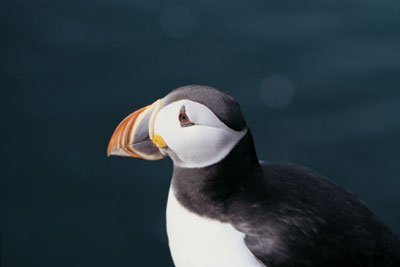
In the summer, there are approximately four to six million Atlantic puffins breeding in the hills of the Westman's largest island, Heimaey (pop. 4,300). In the winter, when we visited, that number drops to two - one named Tritli, the other Skrauta. Both were being nursed back to health by Georg Skæringsson a brick mason, taxi driver, firefighter, and the island's sole mortician who transports the dead in a gold and red Windstar minivan parked outside his modest home. Suringsson and his family found their feathered friends during a celebrated puffin rescue last August. In fact, every summer for as long as anyone can remember, young puffin chicks - called pufflings - are confused by the lights of downtown Heimaey and land in the dark of night in local backyards, gardens, and neighborhood streets in search of open water.
Rather than allow pufflings to fall prey to pet cats, the children of Iceland gather them up wearing ski gloves to protect their hands from sharp triangular-shaped beaks and claws, then take them to the island's Aquarium and Museum of Natural History for weighing before releasing them the next day into the relative safety of the sea. Some are first carried in cardboard boxes to Heimaey's lighthouse for tagging by Oskar Sigurdsson, 68. A third generation lighthouse keeper, Sigurdsson was honored by the Guinness Book of Records in 1997 for holding the record for the most birds ever banded. In 53 years of dedicated banding, he's tagged 85,000 birds in all, of which over 54,000 were puffins. And he's still at it, clamping small metal rings with a return address written in microtype.
According to stacks of thick loose-leaf binders in Sigurdsson's cluttered office with the million kroner view of Heimaey, one puffin was found 36 years later, another was found still inhabiting the same burrow six years after it was first tagged there. Sigurdsson is proudest of tagging a puffin that was later found 2,124 miles away in Portugal. “It's fun to do this and learn how far they can go and how old they live. I'm thrilled when one turns up so far away,” he tells EN through an interpreter.
Baby fulmars, a gull-like relative of the albatross, also land in town, but don't have the same appeal as cute clown-nosed puffins. Fulmars, it seems, have a nasty habit of spitting foul-smelling fish oil from their stomachs as a defensive mechanism. As you can imagine, this tends to dampen the enthusiasm of pint-sized rescuers.
Puffins and the Westman Islands go back a long way. Until the late 1800's, hardy settlers depended upon these “parrots of the sea” for survival. They were eaten and their feathers were used for bedding. Once dried, their bodies were burned as kindling, a welcome luxury in an island with no trees. Even today, while hundreds of children scurry about the town saving baby pufflings, young juveniles are hunted - up to 1,000 per day - and caught in long handled nets for dining room tables throughout the country. It's another quirky Icelandic contradiction that makes the island fascinating to so many explorers and adventure travelers. ( For more information on the Westman's, see www.xtreme.is/vestmannaeyjar.is/?p=100&i=568? ).



