|
Hollywood May Joke, but Elves are Serious
Business for Icelanders
4,000 Enroll in Elf School in Reykjavik
 As
the Will Ferrell comedy film, Elf, continues to attract
moviegoers this holiday season, for the country of Iceland,
elves are no laughing matter. Over 10 percent of the population
of 283,000 believes in them, including Icelandic rocker Bjork.
Roads are designed around the homes of elves, and in some
instances, building plans have been redesigned or abandoned
to avoid disturbing rocks where elves are said to live. As
the Will Ferrell comedy film, Elf, continues to attract
moviegoers this holiday season, for the country of Iceland,
elves are no laughing matter. Over 10 percent of the population
of 283,000 believes in them, including Icelandic rocker Bjork.
Roads are designed around the homes of elves, and in some
instances, building plans have been redesigned or abandoned
to avoid disturbing rocks where elves are said to live.
There's even a Reykjavik school that teaches Elf studies.
When prodded, Icelanders from all walks of life can recount
vivid experiences with supernatural beings. About 10 percent
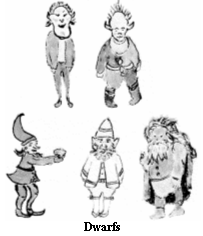
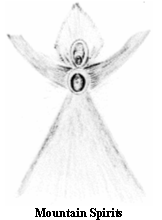
of Icelanders believe in the existence of a "huldufolk"
or a hidden world of elves, dwarfs and spirits with magic
powers. Another 10 percent deny them, but the remaining 80
percent on the North Atlantic island nation either have no
opinion or refuse to rule out their existence, a survey shows.
Elves may be getting their 15 minutes of fame in Hollywood,
but they are nothing new to Icelanders who have told folk
tales of "little people" since the time of the medieval
sagas -- pithy, epic tales dating from the 12th century when
a man never left his home without his sword.
 Builders
of the country's first shopping mall took care to lay electrical
cables and other underground installations well away from
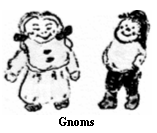
the suspected homes of gnomes and fairies. Couples who are
planning a new house will sometimes hire "elf-spotters"
to make sure the lot is free of spirit folk. Such broadmindedness
might be just self-protection. Tales abound of broken limbs,
busted equipment and other woes befalling builders daring
to go where elves and hidden people traditionally tread. Builders
of the country's first shopping mall took care to lay electrical
cables and other underground installations well away from
the suspected homes of gnomes and fairies. Couples who are
planning a new house will sometimes hire "elf-spotters"
to make sure the lot is free of spirit folk. Such broadmindedness
might be just self-protection. Tales abound of broken limbs,
busted equipment and other woes befalling builders daring
to go where elves and hidden people traditionally tread.
The Iceland road authority typically responds with sensitivity,
routing roads around hallowed boulders or delaying construction
long enough to give non-human constituents time to find new
accommodations.
When bulldozers kept breaking down during work on a new road
a few years ago at Ljarskogar, about three hours drive north
of Reykjavik, road crews solved the problem in an unorthodox
way but one which is fairly common in Iceland. They accepted
an offer from a medium to find out if the land was populated
by elves and, if so, were they causing the
disruptions.
 Viktor
A. Ingolfsson, a spokesman for the road agency, says, "When
Native Americans protest roads being built over ancient burial
grounds, the U.S. listens. It's the same here. There are people
who believe in elves and we don't make fun of them. We try
to deal with them." Viktor
A. Ingolfsson, a spokesman for the road agency, says, "When
Native Americans protest roads being built over ancient burial
grounds, the U.S. listens. It's the same here. There are people
who believe in elves and we don't make fun of them. We try
to deal with them."
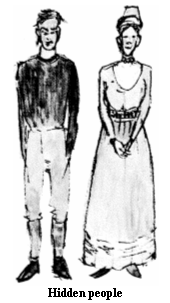
Jon Jonsson, a folklorist who used to teach at the University
of Iceland in Reykjavik, admits he's never seen elves himself,
but has a grandmother who saw them personally and reported
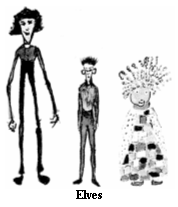
they actually look like normal people who live in hills and
cliffs.
"They are well dressed in the styles of the early 1900's
and don't take kindly to being disturbed," said Jonsson,
now a resident of the West Fjords, about 160 miles northwest
of Reykjavik. "They'll often take revenge if you destroy
their homes or otherwise bother them."
Magnus H. Skarphedinsson, a historian and the headmaster
of the Icelandic Elf School in Reykjavik, has devoted 23 years
documenting eyewitness reports of contact with the hidden
world. He has also helped 4,000 students - mainly Germans,
Scandinavians, Americans and Canadians - successfully complete
their diploma in Elf Studies.
With a curriculum, classrooms, textbooks, diplomas, and ongoing
research, Skarphedinsson teaches about the five different
types of elves, hidden people, and other invisible beings
that inhabit Iceland. It concludes with an afternoon elf hunt
around town, for which tuition is about $48 per person for
groups of three or more.
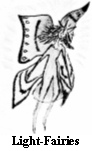
(Illustrations of elfs, hiddenpeople and other beings in
Iceland are from Hidden Worlds Map of Hafnarfjörður.
They are made by Erla Stefánsdóttir.)
|